


Singapore comes up a lot in international teaching circles. It’s not uncommon to hear educators talking about the school resources, safety or salaries.
Then comes the harder question: how do you actually get in? Singapore isn’t a market with thousands of open roles. It’s small, selective and very popular.
That combination changes how the search for school jobs in Singapore feels. Openings are fewer, and competition is sharper. This guide covers where Singapore’s vacancies surface, which schools to target directly, and what makes a candidate competitive.

Why Singapore is one of the toughest markets to break into
Singapore has over 70 international schools, all regulated by the Ministry of Education. That’s modest next to markets spread across a whole country. Singapore is a city-state, so the entire sector sits within one metro area.
The seats are also unusually fixed. Most international schools can’t admit Singapore citizens without ministry permission – only three have a standing exception. That keeps enrolment almost entirely for international students.
It also caps how fast the sector can grow. New campuses open occasionally, but nowhere near the pace of faster-growing markets elsewhere in Asia. Fewer new schools means fewer new roles each year.
What Singapore does offer is scale within its top schools. Singapore American School enrols close to 4,000 students across preschool through grade 12. UWCSEA runs two campuses with a combined roll of just over 6,000.
Its families come from well over 100 countries. These are some of the best-resourced international schools anywhere, and salaries reflect it. Teacher Horizons’ own salary data for Singapore puts the experienced average at $75,200.
Savings potential still sits around 40%, even against Singapore’s higher cost of living. That’s a healthy margin by international teaching standards.
Good pay and strong resourcing mean lower turnover too. Teachers who land a role here tend to stay. So the real challenge isn’t a shortage of great schools, but a shortage of openings relative to demand.
It’s worth being clear-eyed about the trade-off. Singapore’s cost of living sits well above most of the region. Teacher Horizons’ data puts its index at 87 out of 100, against New York as the benchmark of 100.
Rent is the biggest line item here. Fully free accommodation is less common than at some Gulf postings. Most packages build a housing allowance into the salary instead, which is part of why the savings potential still holds up.
1. Specialist international school recruitment platforms
Start with a platform built specifically for international school teachers, not a general jobs site. The details vary a lot between them, so check what actually matters to you. Some charge a yearly fee; others are free.
Some centre on in-person fairs, others on an always-on database. Some pair you with a human adviser; others leave you to search alone.
Teacher Horizons
Quick note: Teacher Horizons is our own platform. We think it’s a genuinely useful place to start a Singapore search, but we’re not a neutral voice on that.
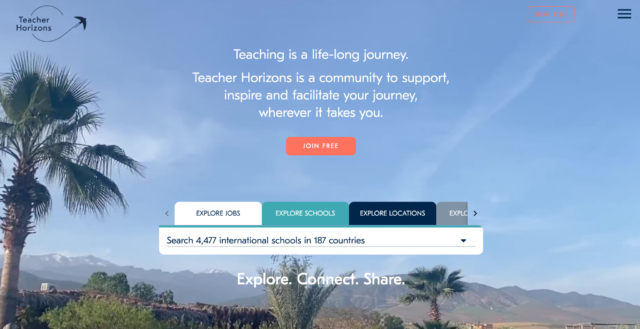
Teacher Horizons is free for teachers. Every candidate is matched with an international adviser; someone who has taught abroad themselves. They pre-screen your profile before it goes anywhere. They can also flag Singapore openings you might not find by browsing alone.
The school search database is especially useful here, where reputation and fit matter enormously. School profiles carry community insights from teachers who’ve actually worked there, not marketing copy from the school itself. For a move this significant, that first-hand knowledge is hard to replace.
Best for: teachers who want personalised support and school-level insight, without paying for either.
2. Direct applications to Singapore’s major school groups
Singapore’s largest international schools recruit heavily through their own career pages, often before a role reaches any third-party platform. If Singapore is a firm target, checking these directly should be part of your routine.
Singapore American School runs an American curriculum with over 20 AP courses. It’s accredited by the Western Association of Schools and Colleges. Its “Work at SAS” page lists current openings by department.
UWCSEA is one of the largest IB World Schools globally, with campuses at Dover and East. Its careers section lists teaching, educational support and relief teaching roles separately. Check more than one category.
Tanglin Trust School, founded in 1925, is the oldest British international school in Southeast Asia. It was rated Outstanding by British Schools Overseas in 2025. Its careers page is updated directly by the school’s own HR team.
Stamford American International School employs more than 450 faculty. It lists openings through its own careers portal.
Several other established groups run their own recruitment cycles and are worth researching directly. Dulwich College Singapore sits within the wider Dulwich College International network. That can mean structured mobility between campuses across Asia for staff who join.
Canadian International School, founded in 1990, enrols around 3,000 students on a Canadian curriculum alongside IB options. Australian International School, Chatsworth International School, and Overseas Family School round out the sector’s larger players. Each has its own culture and hiring rhythm worth understanding first.
Don’t overlook Anglo-Chinese School (International), Hwa Chong International and SJI International either. These are the three schools permitted to admit Singapore citizens directly, so their fees run 15-20% lower than other international schools. Their student mix is different too, which is worth knowing if you’re weighing culture alongside salary.
Many of these schools recruit for multiple grade levels and subjects during the same hiring window. It’s worth checking a career page more than once across the season. A role that wasn’t listed in October may well appear by December.
When you reach out to a school directly, specificity beats enthusiasm:
❌ “I’d love to work at your amazing school and would be a great fit for any role you have.”
✅ “I teach IB MYP Science and noticed your Grade 9 posting closes this month. My last two years have been in a similarly sized IB school in Southeast Asia – happy to share more if useful.”
The second version tells a busy HR team exactly why you’re worth a closer look.
3. Networking – Singapore’s small-world advantage
International teaching is a small world, and Singapore’s community is unusually well-connected. Many current staff have already taught at two or three of the city’s other schools. A significant share of roles here move through recommendation before they’re ever advertised.
A few ways to build into that network:
- Community Networking on Teacher Horizons. Launched in 2025, this LinkedIn-style tool lets you search fellow educators by location, school or subject, and connect with people already in Singapore.
- The TH Ambassador network. Active in 70+ countries, ambassadors share first-hand insight on schools and cities that never makes it into a job listing.
- Former colleagues. If you’ve already taught internationally, your existing network is one of your strongest assets. Singapore especially rewards a warm introduction.

4. Recruitment fairs and events
International recruitment organisations periodically run in-person fairs across Asia, sometimes including Singapore itself. These bring schools and candidates together for structured interviews. Most are invitation-only, offered to candidates with strong, complete profiles.
If you’re working with an adviser, ask directly whether you’d qualify for an invitation this cycle. Fairs suit teachers who are ready to interview now – not those still building a CV.
The upside of a fair is speed. Meeting several schools face to face can compress a months-long search into a single trip. The downside is cost and pressure, so weigh both sides carefully.
Teacher Horizons’ own breakdown of fair pros and cons is worth a read before you commit to one.
Either way, treat a fair as a later step in your search, not your starting point. You need a strong, complete profile before any school will take the meeting seriously.
5. General job boards – useful, but noisy
Sites like Indeed Singapore and LinkedIn do list international school roles, but they sit alongside tuition centre jobs, corporate training roles, and postings with no real connection to the sector. Search by curriculum (IB, British, American) or by school name, and treat these boards as a supplementary check.
6. Timing your Singapore search
Singapore’s international schools follow the same calendar as most of the sector; an August start, with most hiring happening well before that.
- October to February: the main hiring window for the following August. Most vacancies open and close within this period.
- March to May: later-cycle roles, often filled by teachers whose own plans changed.
- June to August: occasional late openings, usually from an unexpected resignation.
Given how few seats open each year, being ready in October puts you ahead of teachers who only start looking in January.

7. What Singapore schools look for
Understanding what a hiring panel is screening for helps you present yourself well, whichever channel brings you the opening.
- A recognised teaching qualification. A degree plus a recognised teaching credential (PGCE, B.Ed, or equivalent) is the baseline. Singapore’s top schools rarely consider unqualified candidates.
- Employment Pass eligibility. Singapore’s Employment Pass currently needs a minimum qualifying salary of $5,600 a month, assessed alongside a points-based framework. Schools handle the application, but it helps to understand the basics before you negotiate an offer.
- Curriculum fluency. Direct experience in the school’s specific curriculum (IB, British or American) carries real weight, given how selective Singapore’s schools can afford to be. If IB is new to you, Teacher Horizons’ guide to the IB learner profile is a useful starting point.
- Two or more years of experience. Most Singapore schools favour established teachers over newly qualified candidates, though strong NQTs occasionally get a look at less oversubscribed schools.
- Professional references. References from a school email address, not a personal one, are standard here.
- Patience with the visa process. Under Singapore’s Fair Consideration Framework, most schools must advertise a role on the national jobs bank for at least 14 days before offering it to a foreign candidate. That’s a regulatory step, not a sign of hesitation.
- Documents ready to go. Digitised copies of your degree, teaching qualification and academic transcripts save time once a school moves to make an offer. A police clearance certificate is commonly requested too, so it’s worth having one on hand before you start applying seriously.
8. How to research a school before you apply
A polished application to the wrong school wastes everyone’s time. Before you apply:
- Check accreditation. Look for recognised bodies like the International Baccalaureate for IB schools, or an equivalent national accreditor for British- or American-curriculum schools.
- Read community insights. School profiles on Teacher Horizons carry first-hand notes from teachers who’ve actually worked there; leadership culture, workload, what the city is really like.
- Look at tenure signals. A school where staff consistently stay five-plus years tells a different story from one that’s always advertising the same subject.
- Understand the group. Schools within a larger network often offer structured development and mobility to other campuses. Standalone schools may offer more autonomy with less institutional backup.
- Confirm the school’s standing. “International school” isn’t a protected term everywhere, but in Singapore it’s tied to Ministry of Education oversight. A genuinely established school will be transparent about its registration and accreditation status.

Frequently asked questions
Do I have to pay to search for a job in Singapore?
Not necessarily. Fees vary by platform and several free options exist, including Teacher Horizons. If cost is a concern, start with the free channels first.
Is Singapore tax-friendly for teachers?
Singapore uses a progressive tax system for residents. Rates generally sit below many Western countries. It isn’t tax-free the way some Gulf postings are, though.
Combined with strong salaries, the real-terms picture still holds up well. Teacher Horizons’ data puts savings potential around 40% for experienced teachers.
How competitive is the Singapore market, really?
More competitive than most. Low turnover at the top schools means fewer openings each year, and Singapore’s reputation draws applicants from across the international teaching world. That said, an industry-wide teacher shortage keeps genuinely strong candidates in demand.
Can my children attend the school I teach at?
Many international schools offer discounted or free places for staff children as part of the package. Policies vary by school, so ask directly during the offer stage rather than assume.
Is it worth using more than one specialist platform at once?
Often, yes, if the platforms are genuinely free. Each one has a slightly different mix of live vacancies and adviser relationships. Casting a wider net rarely costs you anything beyond a bit of extra admin.
Just keep your profile and CV consistent across whichever platforms you use.
What subjects are in demand for school jobs in Singapore?
STEM subjects, IB Diploma Programme specialists, Early Years (EYFS) teachers and special educational needs specialists are consistently sought after. Senior leadership vacancies, like Heads of Department or Deputy Head, also turn up regularly given the sector’s scale.
Do I need a local teaching licence to work in Singapore?
No separate local licence is required beyond your existing qualification and the school’s own vetting. Your Employment Pass and the school’s own registration with the Ministry of Education cover the regulatory side.
How does Singapore compare to other Asian teaching hubs?
Singapore sits at the premium end. Salaries and school resourcing typically run higher than nearby markets. So does the cost of living, and there are simply fewer schools to apply to.
Compare savings potential rather than headline salary. The gap often narrows once rent and daily costs are factored in.
What does the interview process usually look like?
Most Singapore schools run more than one stage. Expect an initial screening call, followed by a more formal panel interview, often held over video for candidates applying from abroad.
Some schools also ask for a short demo lesson or a portfolio of student work. This is more common for subject specialist and leadership roles.
Should I apply if I don’t have Singapore-specific experience?
Yes. Very few candidates arrive with Singapore experience specifically. What schools actually screen for is curriculum experience and a track record in a rigorous international setting.
If you’re unsure how your background will read, ask a Teacher Horizons adviser. They can help you position it for a Singapore audience.

Getting your Singapore search right from the start
Singapore rewards preparation more than most international teaching markets. The schools are excellent, the packages are strong and the competition is real. The teachers who get in are usually the ones who researched properly and applied through more than one channel at once.
Start with a platform that gives you both listings and a person to talk to. Teacher Horizons advisers can help you understand where your experience fits. They can also set expectations for a realistic timeline.
Then work every channel at once, rather than picking one and waiting. Set up your profile on a specialist platform. Bookmark the career pages of the schools you actually want, and let your existing network know you’re looking.
Singapore rarely rewards a single, passive application sitting in one inbox. It rewards teachers who show up consistently, across several channels, until the right opening lines up with the right moment. Persistence, more than any single platform, is what actually gets people through the door.
Research well. Apply early. Follow up like you mean it.